After graduating high school, I entered the workforce early, beginning my career in the planning department of a securities company. The experience was a blend of both rewarding and challenging moments. However, one thing became glaringly obvious to me—the environment was deeply hierarchical and discriminatory. Gender inequality was rampant, and there was a sharp divide between those with college degrees and those without. Despite my dreams and ambitions, I felt trapped in a rigid system. Eventually, I made a life-changing decision: I would leave this job and pursue higher education.
Working with colleagues in fields like economics, business, law, and political science influenced my perspective. I sought something different—something that would challenge my thinking and expand my understanding of life. After debating between literature, history, and philosophy, I ultimately chose philosophy. That decision profoundly shaped my life, and I have never regretted it.
I enrolled at Ewha Womans University. Many, especially those unfamiliar with the institution, have commented on the odd spelling of “Womans” instead of “Women’s.” It reflects the historical English usage from the university’s founding, a detail I’ve had to explain many times over the years whenever organizations questioned the name on my CV. Despite this, I’m proud to have studied at an institution that offered a unique and empowering environment for women.
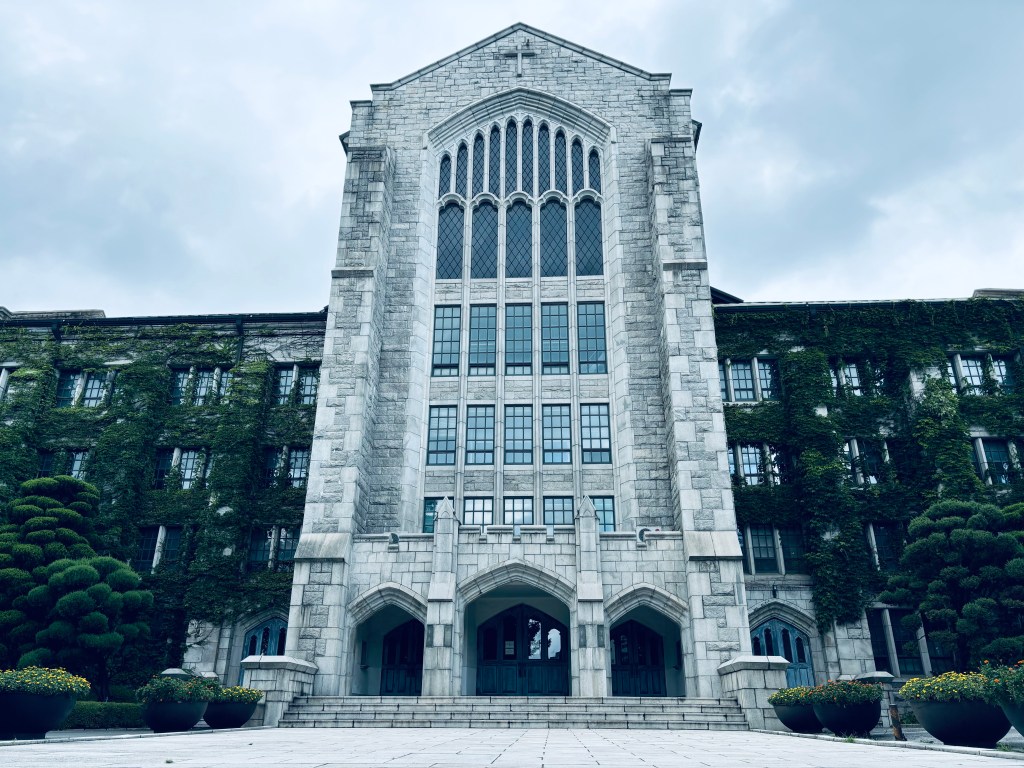
At university, I encountered many remarkable professors who broadened my intellectual horizons. One such professor was Dr. Kim Hei-sook (김혜숙 교수), a distinguished scholar and former president of Ewha Womans University. She is a globally recognized leader in the International Association of Women Philosophers (IAPh). Her guidance left a deep and lasting impression on me.
In our first class, Dr. Kim made a statement that still echoes in my mind: “In society, women are like people with disabilities.” At the time, I was shocked. She explained that women, like individuals with disabilities, are often overlooked if they attempt to blend in without asserting their unique perspectives. They need to embrace their differences to be truly recognized. Initially, I struggled with this idea, but as I encountered various forms of gender discrimination—both in Korea and abroad—I frequently reflected on her words.
Dr. Kim’s teachings extended beyond philosophy; she cultivated a strong sense of self-worth in her students and researchers. I believe my ability to persevere through various roles—whether as a researcher, professional, or later, as a runner—was shaped by this empowering education. Ewha’s supportive environment, where women challenged and nurtured each other, strengthened my resilience and independence.
Some have labeled me a feminist, and perhaps they aren’t wrong. My years at Ewha instilled in me a strong sense of self-respect and empowerment. These values became cornerstones of my identity and have shaped my approach to life.
So, why discuss my university experience in a book about running? Because my mental strength—the ability to endure long, solitary runs—was shaped by the intellectual and emotional training I received at that time. The decision to study philosophy at a women’s university not only influenced my thinking but also how I move through life. These lessons followed me to the remote coffee-growing regions of Ethiopia, where I conducted fieldwork for my research on coffee tourism. My philosophical training helped me withstand isolation and maintain focus, allowing me to complete both my master’s and PhD in this field and continue as an independent researcher today.
Philosophy taught me to appreciate deep reflection, and that habit extended to my physical activities—primarily walking. I wasn’t naturally inclined toward exercise. In my twenties and thirties, I rarely engaged in physical activity beyond slow, leisurely strolls. My walking was deliberate, more akin to how elderly people might move than someone in their prime. I saw no need to exert myself physically; after all, I had enough energy to meet my daily needs. Why push further?
Yet life has a way of revealing unexpected truths. Over time, I came to understand the intimate connection between the mind and body. Just as philosophy requires disciplined mental engagement, I began to realize that my physical self deserved similar attention. This growing awareness eventually led me from walking to running.
My admiration for philosophers—those who devoted their lives to questioning and understanding existence—led me to explore Eastern philosophy. I even spent time in China, immersing myself in its rich traditions. However, I chose not to pursue further studies there. Instead, I returned to Korea, where I earned a master’s degree in arts management and became a classical music event planner. Over the years, I orchestrated more than a hundred performances both domestically and internationally. Later, I found myself promoting major festivals in a small village near Korea’s Demilitarized Zone. The winter festival I helped manage now draws over 1.5 million visitors annually.
These diverse career experiences were underpinned by the intellectual foundation I built through philosophy. Though my journey has taken many turns, philosophy remains at the heart of who I am. It taught me to find meaning in the mundane, to embrace reflection, and ultimately, to keep moving forward—one step at a time.
Just as I grew from walking to running, I believe that life is a continuous process of transformation. Each decision, whether it’s choosing a major or taking that first step on a run, shapes the path ahead. Through these experiences, I have come to understand that both the mind and body thrive on progress and perseverance.
Note:
I am preparing to write a book titled From Walker to Runner and am posting parts of its content on my blog. When I refer to it as a “book” in my writing, it is for this reason, so I hope you understand.
Discover more from Coffee Odysseys
Subscribe to get the latest posts sent to your email.

